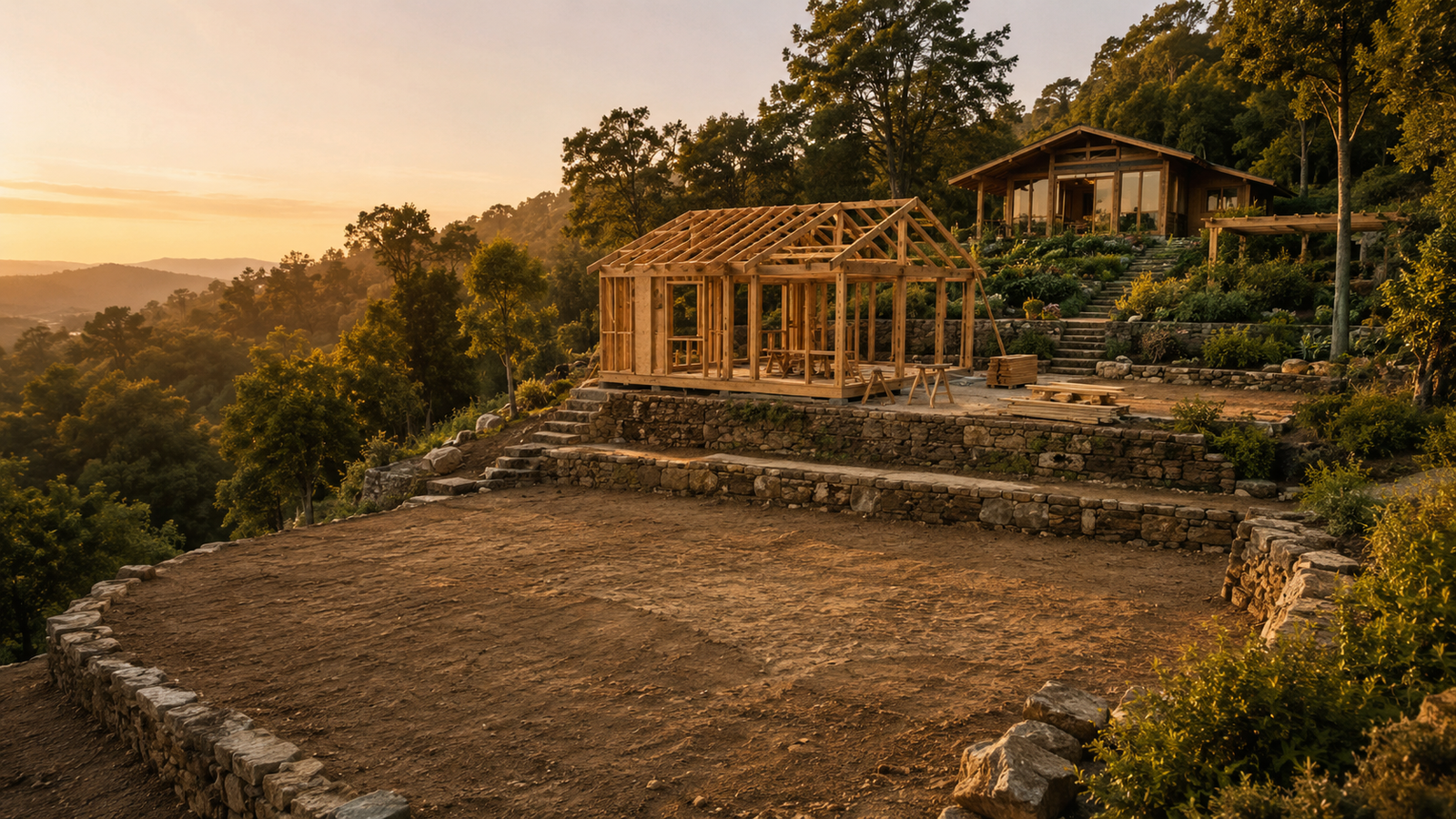
The standard failure mode of an eco retreat project is not that the concept is wrong. It is that the development sequence is wrong. Capital is deployed at maximum scale before a single guest has stayed and given honest feedback. Infrastructure is built to eventual capacity before the market is understood. Six units are constructed simultaneously when the operator has never managed two.
Lusitano Retreat is being built in stages. Not because we lack the capital for a larger first phase, but because the staged approach is structurally superior — lower risk, faster learning, better allocation of both money and time.
**Phase 0 (now):** Land acquisition, PIP process, site planning, food forest planting, infrastructure preparation. Capital required: €35,000–€55,000 for land plus €5,000–€15,000 for access, water, and basic site work. This phase produces no revenue. It produces the physical and legal conditions for Phase 1. The food forest goes in during Phase 0 because the trees need to be growing while everything else is being built.
**Phase 1 (Year 1–2):** Two accommodation units in a rehabilitated rural structure. The target for Phase 1 at ERM004 is the existing ruin: 1,010 m² of urban-classified footprint in Mosteiro, rehabilitated into two self-catering units with private outdoor space. CAPEX estimate: €87,000–€107,000 including land, rehabilitation, furniture, solar, sanitation, and working capital. Licensed as Alojamento Local. Operational as a standalone two-unit retreat from month 1 of opening.
At Phase 1 scale, the financial logic is: break-even at 25–30% occupancy. A two-unit retreat charging €130–€160 per night needs 18–22 nights booked per month to cover its fixed costs. At 40% occupancy — a realistic Year 1 target for a well-photographed rural retreat with strong Airbnb presence — annual revenue is approximately €38,000. EBITDA at 40% occupancy is approximately €12,000–€16,000 depending on operating cost control.
**Phase 2 (Year 2–3):** Two additional units, biological swim pond, fishing pond completion, expanded food production system. The swim pond is the visual centrepiece that shifts the property from 'well-executed rural rental' to 'destination retreat'. Phase 2 CAPEX: €55,000–€80,000. This phase requires Phase 1 to be generating positive cash flow — it is funded from operations and, if timing aligns, from the *Crescer com o Turismo* grant (PT2030, up to 60% of eligible CAPEX, approximately €42,000 on €70,000 eligible base).
**Phase 3 (Year 3–5):** Off-season activation, corporate retreat programming, possible fifth or sixth unit, staff accommodation. Phase 3 is where the economics become genuinely compelling: four units at 55% annual occupancy generates €82,000–€95,000 in revenue. With the established ecological systems and mature food forest, the retreat has something that cannot be replicated by a competitor who opens tomorrow: time in the land.
The grant sequencing is important and often misunderstood. *Crescer com o Turismo* requires the project to be operational before the grant is applied — it is a reimbursement mechanism, not upfront financing. This means Phase 1 must be self-funded and generating revenue before Phase 2 can be grant-assisted. Planning for the grant timeline (application, approval, reimbursement cycle of 12–18 months) means Phase 2 begins in earnest approximately 18–24 months after Phase 1 opens.
The operational advantages of staging are less discussed than the financial ones but equally important. Running a two-unit retreat solo is manageable: cleaning between stays, one changeover per booking period, a kitchen garden that one person can tend in two hours per week. Running a six-unit retreat solo is not. The staged build allows the operator to learn what the actual operational requirements are — how long turnaround cleaning takes, which guests need more support, what breaks first, what the real cost of firewood is in January — before those requirements are multiplied.
Each stage also allows the design language to evolve. The first unit is always the reference piece — the one that establishes the visual and experiential standard. Subsequent units refine it. A retreat that was designed all at once often has a coherence that feels slightly forced; a retreat built stage by stage often has an accumulated authenticity that is harder to design and impossible to fake.
We are currently in Phase 0. PIP is submitted. Trees are being sourced. The staging is not a plan on paper — it is the current operational reality. Phase 1 begins when the PIP is positive and the CPCV is signed.
The philosophy is this: prove it cheaply, prove it honestly, and then do more of what works.