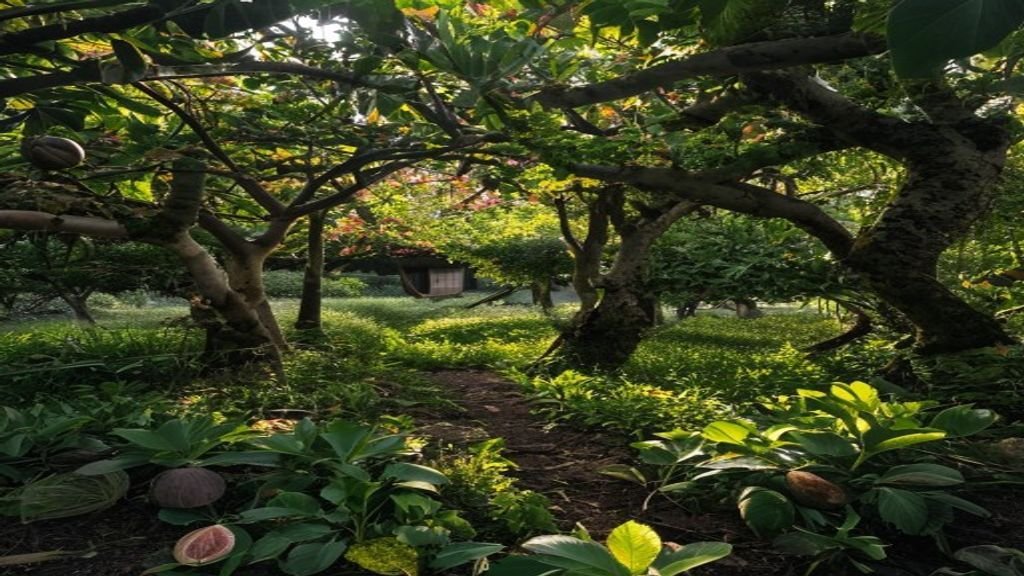
I've read the books. I've done the PDC. I've sat in circles discussing the holmgren principles. And I've been on this land for two years now, trying to make things actually grow and function.
Here's the honest account of what from permaculture theory has been genuinely useful, and what has been more ideology than practice.
## What Actually Works
**Observe first.** This is the first principle — spend time observing before doing — and it is the single most valuable thing permaculture has contributed to how we work. In our first spring, we walked the land at different times of day for three months before building anything or planting anything significant. We noticed where the water pooled after rain. We found the sunny south-facing slope that's sheltered from the east wind — now our best growing area. We discovered a natural hollow that fills with cold air on still nights — now our frost pocket warning zone. None of this would have been obvious from a map.
**Use edges.** The principle that productivity is highest at the boundary between systems (forest edge, pond margin, field edge) has been consistently confirmed in our experience. Our most biodiverse and productive planting areas are exactly at these transition zones. The orchard planted at the forest edge grows faster and fruits earlier than the trees in the open field.
**Stack functions.** Everything we plant or build has at least three functions. The elder hedge is: windbreak + wildlife habitat + elderflower harvest + elderberry medicine. The comfrey is: groundcover + dynamic accumulator + bee forage + compost activator. This principle forces better design thinking and eliminates single-purpose infrastructure.
**Work with succession.** Rather than fighting the natural succession from open grassland to scrub to woodland, we planted pioneer species (elder, rowan, birch) to create shelter and improve soil conditions for the longer-lived species (oak, chestnut, pear) planted behind them.
## What Has Been Less Useful
**The zone system applied rigidly.** Zone 1 (most visited, most intensively managed) nearest the house, Zone 5 (wild, unmanaged) furthest away is a sensible general principle. But on our irregular hillside with its stream, natural woodland patches, and existing stone walls, the linear zone model was a straitjacket. We ended up with a Zone 1 kitchen garden that's 200m from the house because that's where the best soil and sun is, and a Zone 3 food forest that's closer than the Zone 2 orchard. Reality beats theory.
**Guilds.** The idea that you plant companion species around each tree in a defined guild (three sisters, apple guild, etc.) sounds elegant. In practice, on our scale with our soil and climate, we found simpler groundcover strategies (mass comfrey planting + dynamic mulching) worked better than carefully planned multi-species guilds around each individual tree. Maybe at a smaller homestead scale, guilds make more sense.
**The PDC knowledge transfer problem.** A Permaculture Design Certificate is 72 hours of education and costs €800–2,500. Most of that time is spent learning design methodology rather than practical horticultural, ecological, or construction skills. For someone implementing a real project on real land, a good book on no-dig vegetable growing, a good book on native tree planting, and one conversation with a local agronomist will be more practically useful than a PDC. The PDC is valuable as a way of thinking, not as practical training.
## The Bottom Line
Permaculture's contribution to how we work is primarily philosophical: observe more, intervene less, work with natural systems rather than against them. These principles are valuable and consistently vindicated on our land.
But permaculture as a dogmatic practice — with its jargon, its ideological tendency, and its occasional tendency to substitute complexity for action — is something we've largely left behind. Good farming, good forestry, and good ecological design have been doing most of what permaculture describes for centuries, without the branding.
Use the ideas. Question the ideology.
---
*We offer practical land design consultations for eco retreat projects in Norte. Enquire below.*