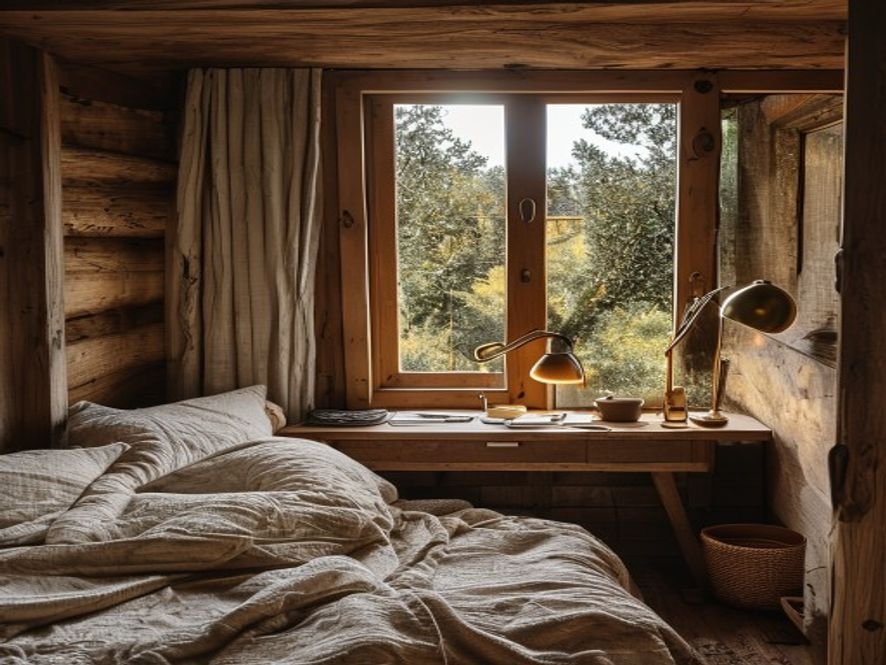
If you ask guests what surprised them most about their first day, the answer is almost always the same: the silence.
Not the absence of sound — there is constant sound here: the stream, the birds, the wind in the chestnut canopy, the occasional distant bell from the village herd. What guests mean is the absence of the specific quality of noise they live inside at home: digital notification sounds, traffic, the low-frequency hum of urban electrical infrastructure, the ambient chatter of open-plan offices.
That absence is not an accident. It was designed.
## Acoustic Site Planning
The most important acoustic decision we made was the location of the car park. It is 180 metres from the nearest accommodation unit, separated by the food forest planting zone, slightly uphill (so sounds don't carry down toward the buildings), and behind a stone wall that absorbs rather than reflects.
Guests arrive by car and then walk in. The 180-metre walk is the decompression corridor. By the time they reach the main building, they have already shed the most obvious layer of arrival stress. They have heard the stream, smelled the wood smoke (if it's cool), and not heard a single car engine.
This sounds like a small thing. Our guest review data suggests it is not.
## Sound Mapping Before Building
We walked the site at six different times of day — 6am, 9am, noon, 3pm, 7pm, 10pm — before finalising accommodation locations. The goal was to identify: where is it quietest? Where do natural sounds predominate? Where does any ambient noise (a distant road, the village) reach?
We found that the hillside creates a natural sound shadow at approximately 120m from the lower track — sounds from the road below effectively disappear. We positioned the glamping units in this shadow zone.
We also found that the area closest to the stream was both the most acoustically pleasing (the water creates what sound designers call "white noise" — a continuous broadband masking sound that reduces the perceptibility of other sounds) and the most visually connected to the biological pond. The two best sites aligned. When site planning works like this, you know you've read the land correctly.
## Interior Acoustic Design
The main communal building is renovated stone — 60cm thick granite walls. Stone is an exceptional acoustic material: it absorbs mid-frequency sound and creates a natural reverberation that is neither dead (anechoic) nor reverberant (echoing). People find it instinctively comfortable for conversation.
We avoided hard parallel surfaces where possible: no facing plaster/plaster pairs on opposite walls, wooden ceiling rather than concrete, heavy wool textiles for seat and floor coverings. The acoustic result is a room where multiple conversations can happen simultaneously without noise competition.
In the accommodation units (bell tents), the canvas material is itself an excellent sound absorber. Rain sounds beautiful from inside canvas. Wind sounds like wind rather than a threat. The material communicates "you are inside something temporary and natural" in a way that wood and plaster don't.
## The Sound Policy
We don't have a blanket silence rule. Silence rules create policing dynamics that run counter to genuine rest. What we do have is:
- No amplified music in shared spaces (the kitchen has no speakers; the communal fire area has no speakers) - No phone calls in shared spaces (very easy to maintain where there's no signal) - No alarm clocks (breakfast is ready when the kitchen starts smelling of it, not at a fixed hour during the first two days)
These are policies framed as gifts rather than restrictions. Nobody has ever complained about them.
## The Paradox
The most common feedback from guests about the silence is that they initially found it uncomfortable, and that by day three they were reluctant to lose it. Several have described it as one of the most disorienting aspects of returning home — the rediscovery of how noisy their normal environment is.
That discomfort of return is, we think, the most valuable outcome of the whole experience. You can't unhear the silence.
---
*Our retreats are designed around acoustic comfort as a therapeutic tool. See our accommodation page for details.*