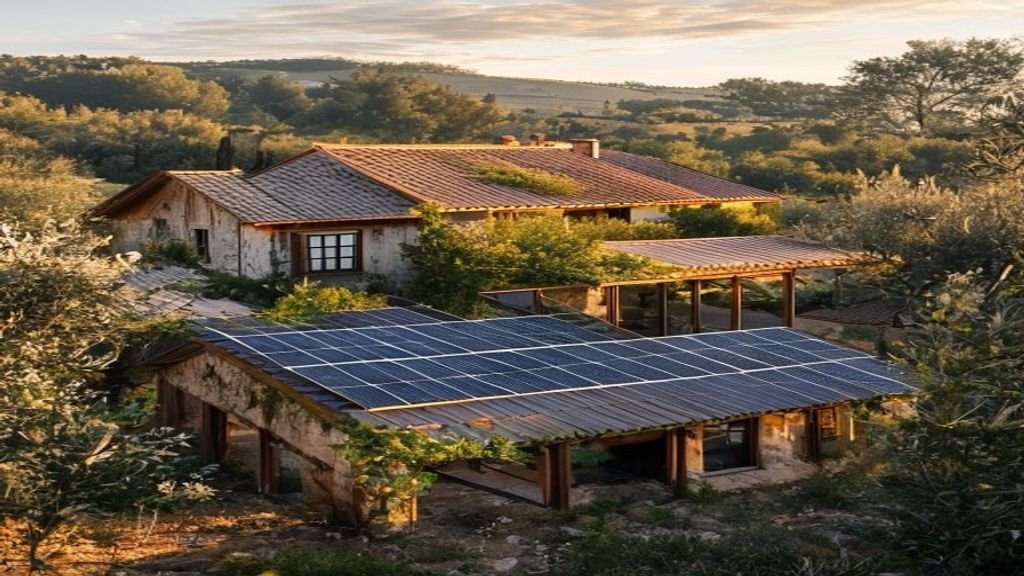
Off-grid solar is frequently discussed in terms of peak output and theoretical self-sufficiency. We've been running the system for two years and we'd like to share what it actually does, month by month, in the Norte Portugal climate.
## The System
- **Solar array:** 11.4kWp (24 x 475W panels), south-facing at 30° tilt - **Battery storage:** 20kWh usable (Pylontech US5000 units, 4 x 5kWh) - **Inverter/charger:** Victron Quattro 48/10000, with a Cerbo GX monitoring unit - **Backup:** 6kVA diesel generator, used as fallback
The system was sized for a maximum of 10 guests plus two permanent residents, with typical daily load of 12–18kWh depending on season and occupancy.
## Norte Irradiance — Reality vs Published Figures
The published peak sun hours (PSH) figure for northern Minho is approximately 1,650–1,700 hours per year. This is accurate as an annual average. What it obscures is the monthly variance, which is the figure that actually matters for system sizing.
**Actual monthly production from our system (approximate averages):**
- January: 280–320 kWh - February: 380–420 kWh - March: 600–660 kWh - April: 820–900 kWh - May: 1,000–1,100 kWh - June: 1,150–1,250 kWh - July: 1,200–1,300 kWh - August: 1,100–1,200 kWh - September: 820–900 kWh - October: 550–620 kWh - November: 320–380 kWh - December: 240–290 kWh
The ratio between our worst month (December/January) and best month (July) is roughly 1:4.5. This is the number that matters for system design, not the annual average.
## What Runs Off Solar
During the productive months (March–October), the solar system handles essentially all loads: cooking (induction hobs), water heating (two 200-litre immersion tanks, usually charged by late morning), lighting, pumps, guest device charging, and the Starlink satellite internet.
The one load we run on a timer to avoid peak solar-only demand is the washing machine — set to run between 10am and 2pm on sunny days.
Peak daily consumption on a full-retreat day with 10 guests: approximately 18–22kWh. Peak daily production in June: approximately 55–60kWh. In June we are generating roughly 3x what we use; the battery fills by mid-morning and we export nothing (no grid connection).
## Winter: The Reality
Five to six consecutive overcast or rainy days are not unusual in November–February. This is the part of the off-grid solar narrative that frequently gets omitted.
After three consecutive fully overcast days, our 20kWh battery bank, even with conservative management, is down to 30–40% state of charge. The monitoring system triggers a generator run at 25% SoC. In practice, during winter retreat weeks we run the generator for approximately 2–3 hours per day on cloudy stretches, typically in the morning before solar production resumes.
Generator diesel consumption per hour: approximately 1.2 litres at typical load. A winter week with 4 cloudy days: roughly 10–12 litres of diesel, approximately €15–18 at current prices.
This is not a failure of the system — it's honest physics. A solar-only off-grid installation in northern Portugal in winter needs battery capacity that would be disproportionate in cost relative to its use. The diesel backup is the correct engineering solution for the infrequent cloudy periods. Anyone selling you a fully solar off-grid system in Norte Portugal for year-round use without addressing this is either oversizing the battery at significant cost or underselling the problem.
## Financial Case
Before the solar installation, we had a grid connection and a typical rural Portuguese electricity tariff. Annual electricity cost: approximately €3,200 (grid supply, retreats and domestic combined).
The solar installation cost €22,500, including panels, inverter, batteries, wiring, and installation. Annualised diesel cost for generator backup: approximately €180.
Effective annual electricity cost post-installation: approximately €180 (diesel only). Saving: approximately €3,020 per year.
Simple payback period: approximately 7.4 years.
This is a reasonable return for infrastructure that should last 20+ years (Victron inverters typically run 15–25 years; Pylontech batteries have a rated 6,000-cycle life at 80% depth of discharge, which at daily cycling represents 16+ years).
## What We'd Size Differently
Two things.
First: we'd increase battery capacity to 30kWh. The additional 10kWh would significantly reduce generator use in winter and provide better overnight buffer for high-consumption summer nights. Current cost for additional Pylontech capacity: approximately €3,500. We'll add this in year three.
Second: we underspecified water heating capacity. Two 200-litre immersion tanks are sufficient for 6 guests but create pressure during 10-guest retreats if back-to-back hot showers happen faster than solar can reheat. A third tank — approximately €400 installed — would resolve this. Planned for this autumn.
---
*If you're designing an off-grid energy system for a rural property in Norte and want to talk through the actual numbers rather than the theoretical ones, drop us a message.*