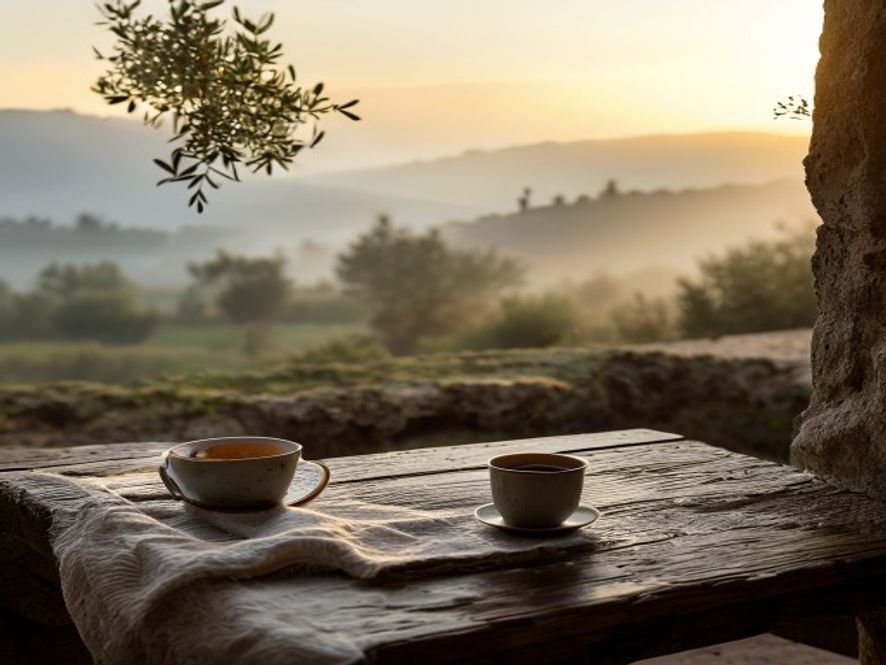
She arrived on a Sunday afternoon in early October, when the light in Norte Portugal turns amber at four o'clock and the valley goes quiet in a way that seems deliberate. She had driven from Porto airport herself, which she mentioned twice in the first hour — as if driving to a retreat alone was something she needed to justify. She was 41. She worked in financial services in London. She had booked the week without telling her office she was going somewhere with no mobile signal.
This is a composite portrait. The details are drawn from several guests we have known, but no single person is described here.
## Day One: Resistance
The first day of a retreat is often the most uncomfortable. The city mind arrives with its scheduling instincts intact — the urge to optimise, to check, to plan the next thing before this thing is finished. Sitting through a 75-minute morning yoga session in silence when you haven't done yoga in four years and your hamstrings are announcing themselves loudly is not immediately enjoyable.
We have learned not to over-programme the first day. There is a group dinner in the evening, which tends to work better than any structured activity for breaking down the initial brittleness. Guests who have travelled from different countries find common ground over food faster than they do over meditation. By the third glass of wine, the financial services executive from London is talking to a graphic designer from Berlin about what they would do if they could do anything. That conversation rarely happens in London or Berlin.
## Days Two Through Four: The Land
The middle of the week is where the change, if it happens, tends to begin. The programme includes morning yoga, a silent breakfast, land work in the late morning, free time in the afternoon, and a facilitated group session in the evening. The land work is not therapeutic in design — it is practical. Guests mulch trees, harvest vegetables, carry water, plant things. The physical rhythm is different from exercise. There is a task with a visible outcome, and it is unhurried.
Our guest spent an afternoon in the food forest on day three, weeding around a row of young chestnut saplings we had planted the previous autumn. She worked for two hours without conversation and told us afterwards that she had not had two consecutive hours without spoken or written words in she couldn't remember how long. The chestnuts did not care how she performed. Neither did we. That, she said, was part of the point.
The land also has a quality that is difficult to describe precisely but that most guests comment on. Things are alive here in a visible way — the pond, the old oaks, the birds, the fungal networks showing themselves as mushrooms after the first autumn rains. Something about that aliveness seems to calibrate human scale. The problems that felt enormous in London become legible as the ordinary difficulties of a life, rather than evidence of a fundamental failure.
## Day Five: The Shift
We cannot manufacture the moment of shift. We have watched it happen to many guests and we can design conditions that make it more likely, but it remains stubbornly personal. For some guests it comes through the body — after a particularly demanding yoga session or a long walk in the hills above the property. For others it comes through something said in the evening group session. For a few, it is simply time — the cumulative effect of several days of adequate sleep, physical activity, good food, and freedom from a screen.
Our guest's shift was quiet. On day five, she sat at the outdoor table after breakfast — still the silent breakfast, still without her phone — and did not move for almost an hour. We saw her from the kitchen window. She was not meditating formally. She was just there, present in the way that is rare and that most people have forgotten is possible.
## The Closing Circle
On the final morning, we sit together as a group. Each person speaks: what they are taking with them, what they are leaving behind. This is not a therapy session and we do not frame it as one. But the quality of what people say in these circles, week after week, is moving.
Our guest said she was leaving behind a story she had been telling about what her life needed to look like. She said this quietly, without drama, as if reporting a fact.
## What We Design For
Transformation of this kind is not manufactured. It is not produced by a particular yoga sequence or a particularly skilled facilitator. It is produced by conditions:
- Enough time (a week is the minimum; a weekend is not enough for the city mind to decompress) - Adequate removal from ordinary stimuli (no mobile signal helps; we do not apologise for this) - Physical engagement with living systems — land, food, body - A small, trusting group - Facilitators who are present without being intrusive
We design for those conditions. What happens within them belongs to the guest.
---
*Our 7-day autumn programme opens for applications in June. Details at [lusitanoretreat.com](https://lusitanoretreat.com).*