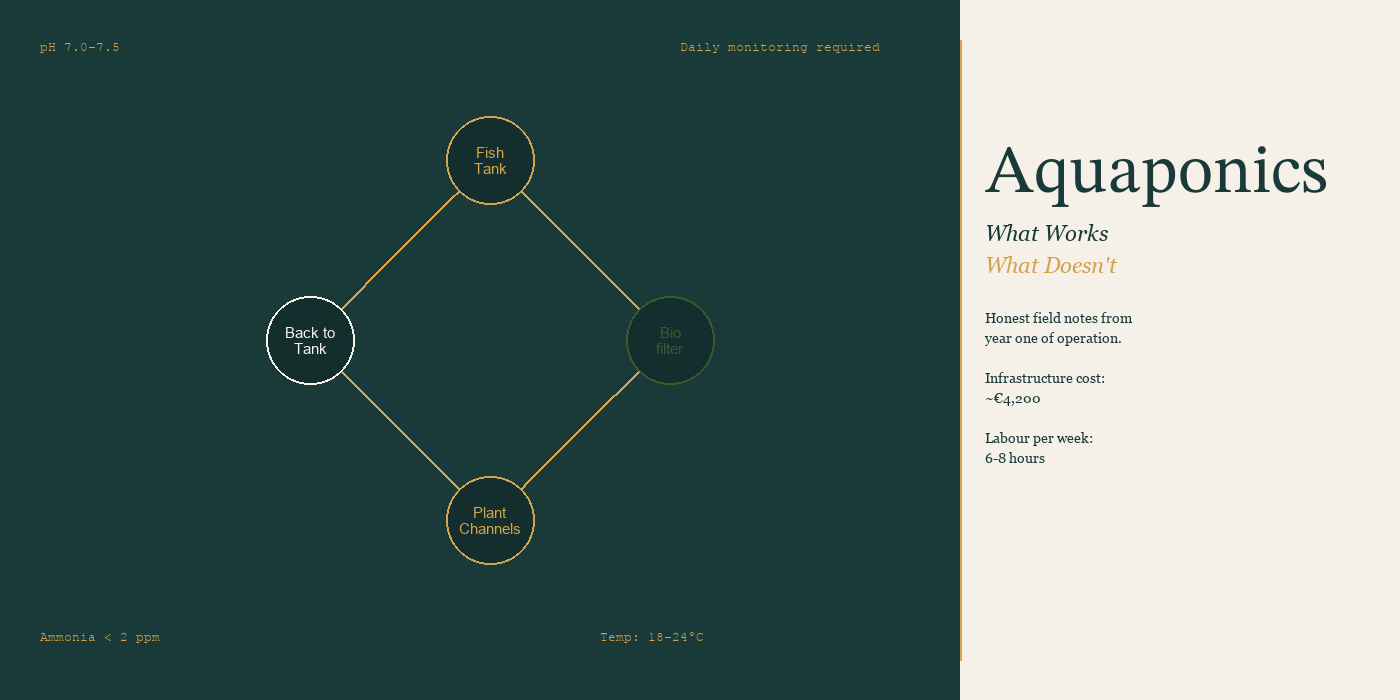
Aquaponics appears frequently in the planning notes of eco retreat developers, usually somewhere between 'biological swim pond' and 'solar array' on the list of systems that will make the property both self-sufficient and impressive. The appeal is obvious: fish produce waste, waste fertilises plants, plants filter water back to the fish, and the cycle produces both protein and vegetables with no external inputs. In practice, the system is real, the cycle works, and the scale at which it is worth building for a small retreat is considerably smaller than most people imagine.
The entry-level aquaponics setup for a retreat context is an IBC tote system. An IBC — Intermediate Bulk Container — is a 1,000-litre plastic tank inside a steel cage, sold second-hand throughout Europe for €50–€150 each. A minimal functioning system uses four IBCs: one fish tank (the lower half of a cut IBC), one sump tank for water collection, and two grow beds filled with clay pebbles or volcanic rock (hydroton or leca) where plant roots sit in the nutrient-rich water. Total materials cost: approximately €800–€1,200 for a four-IBC system with a small submersible pump, timer, and basic pipework.
The fish choice matters more than most guides acknowledge. The default recommendation in aquaponics literature is tilapia — a warm-water species that grows fast and tolerates high stocking densities. In the Minho, tilapia is not viable in an outdoor system. The species dies when water temperature drops below 12–15°C, and North Portugal winters deliver 4–8°C nights from November through February. Running tilapia through a Minho winter requires a heated greenhouse or heated indoor tanks — adding €3,000–€8,000 in infrastructure that changes the economics of the entire system.
The more practical fish for an outdoor aquaponics system in the Minho is common carp (*Cyprinus carpio*) or, for smaller systems, goldfish. Carp tolerates a temperature range of 4–35°C, grows steadily on algae and pellet feed, and produces consistent waste nitrogen to drive plant growth. It is not a premium food fish — but it is a functioning biological component that keeps the nitrogen cycle running year-round without supplemental heating. Catfish (*Silurus glanis* or *Ameiurus melas*) is a reasonable alternative: cold-tolerant, bottom-dwelling, and large enough to produce meaningful nutrient output from a relatively small system.
On the plant side, aquaponics systems genuinely excel at leafy greens and herbs. Lettuce, pak choi, spinach, basil, and mint thrive in nutrient-film technique (NFT) channels or in flooded grow beds. In a four-IBC system running year-round, a realistic yield is 8–12 heads of lettuce per week during the growing season — enough to supply a retreat kitchen with salad greens, but not enough to replace a weekly trip to the market. Fruiting plants (tomatoes, peppers, cucumbers) can be grown aquaponically but require more nutrient density and more careful pH management than leafy greens — the system becomes significantly more demanding.
The daily monitoring reality is not dramatic but it is non-negotiable. Aquaponics is a living system in which fish and plants are interdependent, and in which several variables must stay within range for both to survive. pH should sit between 6.8 and 7.2 — too low and beneficial bacteria cannot thrive; too high and ammonia becomes toxic. Dissolved oxygen must stay above 5 mg/L for fish survival. Ammonia and nitrite should both read near zero in a cycled system. These parameters require a basic test kit (approximately €30 for a liquid test kit) and 10–15 minutes of testing every 2–3 days when the system is established, daily when it is cycling.
What goes wrong, and what goes wrong badly. Fish die during power cuts: in a system with no aeration backup, a 4-hour power failure in summer can crash oxygen levels and kill the entire stock. A small battery-powered air pump (€20) as backup prevents this, but it requires remembering to test the battery. Plants bolt in summer heat: lettuce in a North Portugal July, even in a shaded system, will often go to seed in 3–4 weeks rather than giving you 6–8 weeks of harvesting. Algae blooms in any grow bed that receives direct sunlight. The solution — opaque covers on all water surfaces — is simple but adds cost and complication. None of these problems are fatal. All of them require the operator to be paying attention.
The guest experience argument is the strongest case for a retreat-scale aquaponics system. Guests find it fascinating in a way that is disproportionate to its actual scale. A four-IBC system in a shaded corner of the property, with fish visible through the tank walls and lettuce growing from gravel channels, generates more curiosity and conversation than almost any other feature of equivalent cost. It is an exhibit. It teaches something real about closed-loop food systems, nitrogen cycles, and the relationship between animal waste and plant growth. For guests who have never thought about where their food comes from, it is genuinely illuminating.
The honest verdict: build the aquaponics system in Phase 1 or Phase 2 as an educational feature and a kitchen supplement, not as a food production system or a revenue stream. Keep it at four-IBC scale or smaller. Choose carp or catfish over tilapia. Grow leafy greens, not tomatoes. Check the parameters every few days. Put a battery backup on the air pump. And when guests cluster around the fish tank asking how it works, tell them — that conversation is worth the €1,000 the system cost to build.