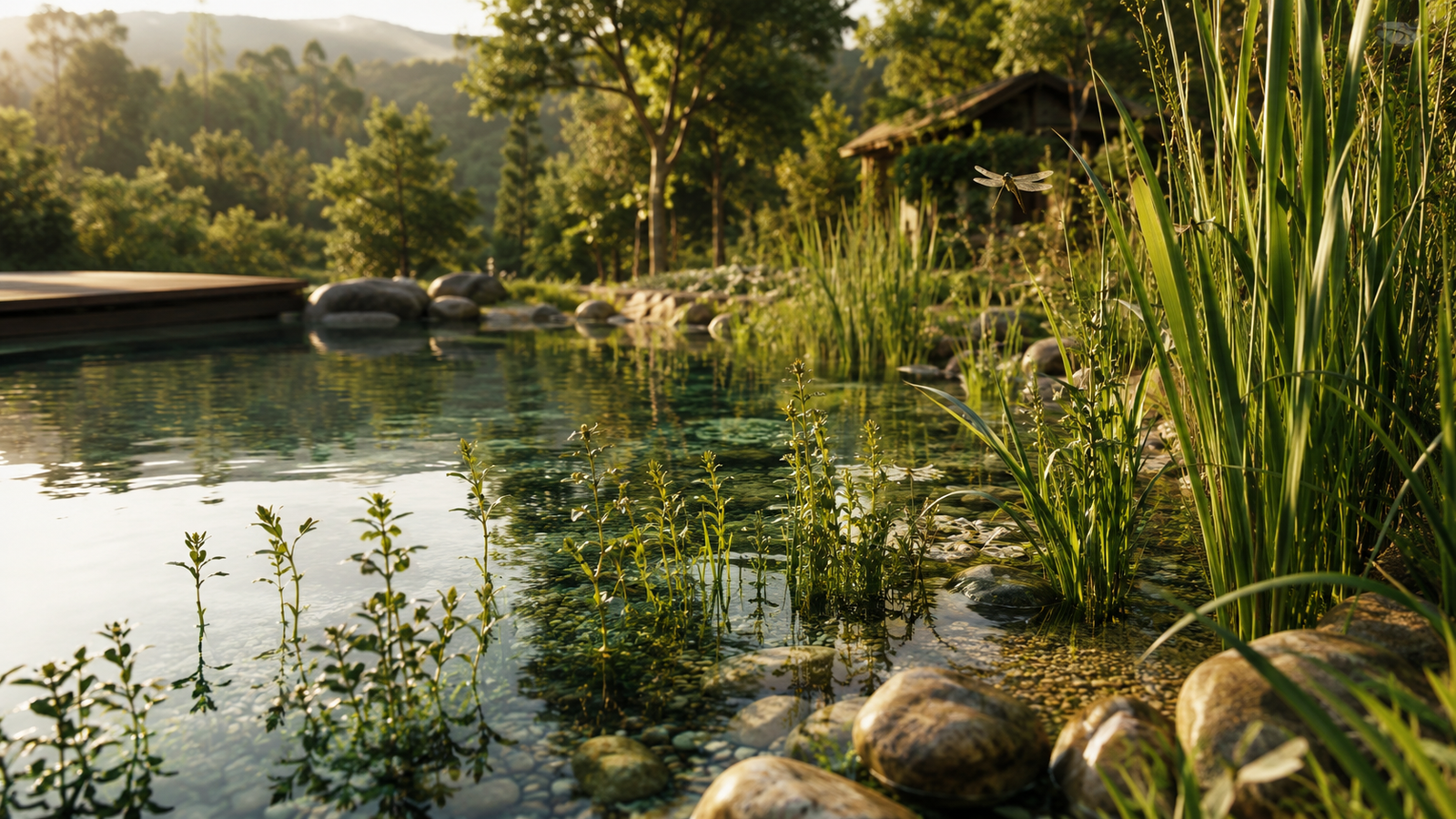
The most common question we get from potential guests is: "Is the pond safe to swim in?"
Yes. But the answer to why it's safe — without chlorine, without filters, without chemicals — is one of the most satisfying explanations in ecological design. Let us walk you through it.
## What Is a Biological Swimming Pond?
A biological swimming pond (piscina biológica) is a body of water that cleans itself using living systems instead of chemistry. It has two distinct zones that work together:
**The swimming zone** is the deep, clear area where you actually swim. It looks like a conventional pool — clean water, visible bottom — but without any chemical treatment whatsoever.
**The regeneration zone** is the shallower planted margin surrounding it, typically 30–60cm deep. This is where the ecological work happens. Submerged and emergent aquatic plants — water irises, rushes, reeds, hornwort — absorb the nutrients, phosphorus, and nitrogen that would otherwise feed algae. The substrate beneath them acts as a biological filter, hosting billions of micro-organisms that process organic matter before the water recirculates into the swimming zone.
A small pump runs 24 hours a day, drawing water from the swimming zone through the regeneration zone and back again. That's the entire mechanical system.
## Why It Works Better Than a Conventional Pool
Chlorinated pools are effective at killing pathogens. They're also effective at irritating skin, bleaching hair, causing respiratory problems in enclosed spaces, and creating carcinogenic disinfection by-products (chloramines) when they react with body oils and urine.
A properly designed biological pond has none of this. The water is soft and neutral. Swimmers don't smell of chemicals after getting out. Children can swallow small amounts without concern.
Water quality in a well-designed system routinely exceeds EU Bathing Water Directive standards — the same benchmark used for certified natural bathing sites — without any chemical input.
## The 12-Month Establishment Period
This is the one thing that surprises people most: a biological pond cannot be rushed. The ecological community — the micro-organisms, the biofilm on the substrate, the plant root systems — needs approximately 12 months to establish before the water reaches stable clarity.
In the first summer, you may see some green tinting. This is normal and expected. By the second season, the system reaches dynamic equilibrium. Many owners of established biological ponds in the UK and Germany report not needing to do any maintenance other than annual plant harvesting to remove accumulated biomass.
## What We Monitor
Even though we don't add chemicals, we do monitor water quality regularly:
- **pH** — maintained between 6.8 and 7.8 - **Turbidity** — water clarity measured in NTU (Nephelometric Turbidity Units) - **Total phosphorus** — the primary nutrient that feeds algal blooms - **E. coli** — monthly during swimming season via a certified laboratory
The goal isn't to add anything — it's to catch early signs of imbalance before they become visible problems.
## What Guests Actually Experience
Guests swim in water that feels fundamentally different from a pool. It's cooler (our pond stabilises at 22–26°C in high summer), softer, and alive in a way that's difficult to describe but immediately felt. Dragonflies land on the surface. Frogs call from the margins in the evening. Small water beetles navigate the edges.
This is not a feature we added. It's what happens when you build a biological system and let it become what it wants to be.
---
*Questions about our pond design or water quality data? Get in touch.*