Every planning process in Portugal runs through the Câmara Municipal — the local council. For a rural retreat developer, the Câmara is the institution that decides what you can build, in what form, to what standard, and in what timeframe. Understanding how to navigate it is not optional. It is the central skill of the first phase of any project like this.
The first thing to understand is that the Câmara is not a monolith. It is a collection of individual departments, each with its own workload, culture, and relationship to the municipalities development policy. The planning department (Divisão de Gestão Urbanística or similar, depending on the Câmara) is where you need to be. Not reception. Not the general enquiry desk. The técnico de planeamento — the planning technician — is the person whose job it is to understand and apply the PDM. That is the person you need to reach.
Getting to the técnico de planeamento often requires navigating through reception first. Receptionists in Portuguese public offices are, as a rule, friendly and genuinely trying to help, but they are not trained in planning law and will sometimes give you an answer that is approximately right or confidently wrong. The phrase that tends to work is: 'Preciso de falar com um técnico de planeamento urbano sobre um pedido de informação prévia' — 'I need to speak with an urban planning technician about a prior information request.' This signals that you know what a PIP is, which signals that you are worth escalating to someone who can actually answer.
What to bring to the meeting: a printed site plan showing the parcel boundaries, ideally with the artigo number clearly marked; a copy of the caderneta predial (the fiscal property description, available from AT — Autoridade Tributária — for approximately €15 online); a brief written summary in Portuguese of your intended use, translated if necessary. You do not need a completed architectural project. You do not need a lawyer present. You need enough documentation to make your question specific and your intent clear. Vague questions receive vague answers.
The written PIP versus the verbal indication. In our experience navigating multiple Câmaras in the Norte region, a técnico will often give you a verbal indication that is genuinely useful — a strong sense of whether the intended use is compatible with the PDM zone, whether the building footprint is within permitted limits, whether a particular rehabilitation route is likely to be approved. This verbal indication is informative and worth noting. It is not legally binding. The only document that is legally binding is the written PIP response, and it is the only basis on which you should make a capital commitment.
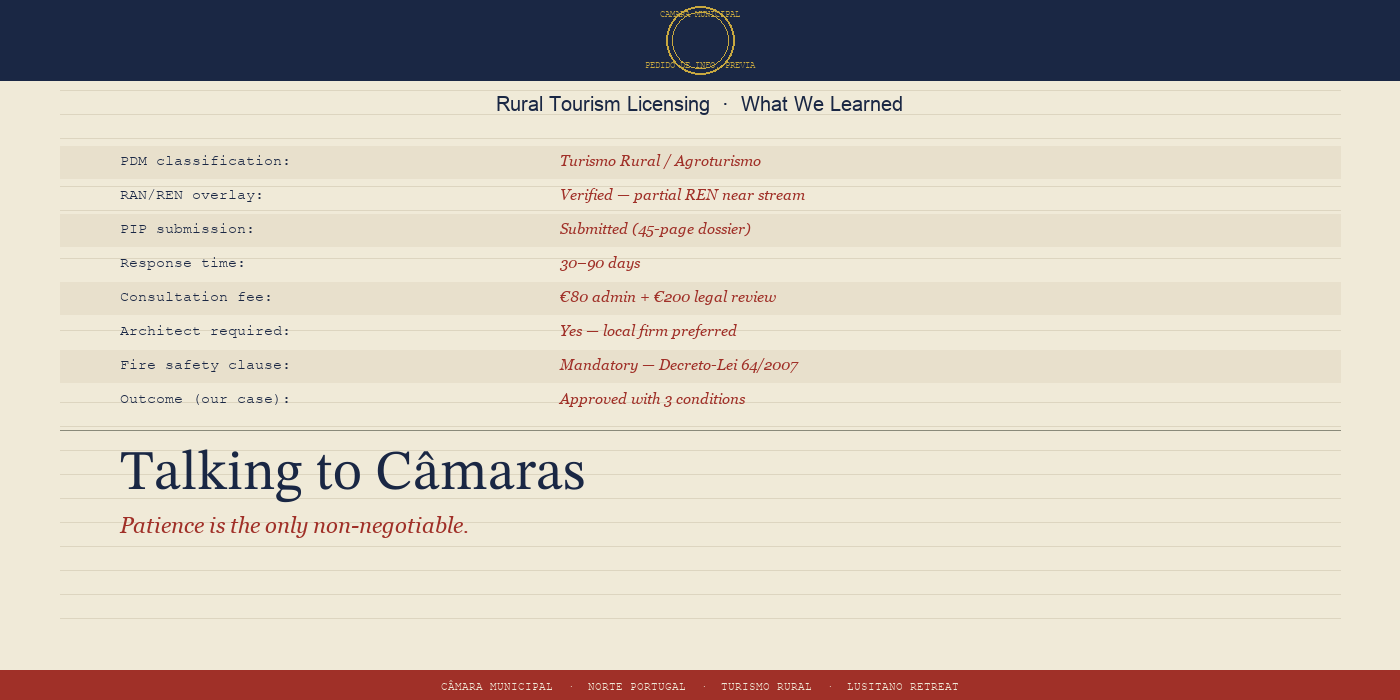
Timelines. The legal framework specifies that a PIP must be decided within 30–45 days of submission. In practice, we have observed timelines ranging from 28 days (Vieira do Minho, for a straightforward urban parcel with clear PDM classification) to over four months (a Câmara we will not name, for a mixed-classification parcel that required internal consultation between departments). The 30-day figure is useful for planning optimistically; the 3–6 month figure is useful for planning your actual cash flow and development timeline. Do not schedule architect engagement, contractor mobilisation, or CPCV completion to coincide with the expected PIP response date. Schedule those for after the written response is in your hands.
The value of a local architect who knows the Câmara cannot be overstated, and it is something that almost no development guide mentions explicitly. An architect who has submitted 30 previous applications to the Câmara Municipal de Vieira do Minho knows which técnico handles rural rehabilitation requests, knows the phrasing that tends to produce a positive response, knows the specific PDM articles that support the use you are requesting, and knows when an informal phone call to the department will move a stalled application forward. This knowledge is not transferable in a document. It lives in the relationship. The fee for a local architect in Norte Portugal for a rural rehabilitation project ranges from €3,000 to €8,000 for the full process — it is one of the highest-returning professional fees in the project.
The language barrier is real but manageable. Our experience is that Google Translate running on a phone, held up for a técnico to read a sentence or two, is entirely acceptable in a municipal planning office — it is a common mode of interaction with foreign developers and is met with patience rather than hostility. A prepared document in Portuguese (even machine-translated and then reviewed by a native speaker) is considerably more effective than a phone screen. For any written submission — a PIP, a statement of intent, a request for clarification — spend the €30–€50 to have it reviewed by a translator or a bilingual contact before submitting.
What makes a Câmara developer-friendly varies significantly across municipalities. Vieira do Minho has an active rural tourism policy — the municipality has been promoting rural development for over a decade and the planning department is oriented toward facilitating compliant projects rather than obstructing them. This does not mean everything is approved: the PDM applies, the RAN/REN restrictions apply, and wildfire zone constraints apply identically. It means that a compliant application is more likely to receive a cooperative response and a faster turnaround. Some coastal Câmaras in the Algarve and Alentejo coastal strip have become considerably more restrictive in recent years as a result of overdevelopment pressure — the same application that would take six weeks in Vieira do Minho might take six months in a municipality managing AL containment zones.
The emotional reality of dealing with Portuguese planning administration. It is slow. It is paper-heavy. It requires you to wait without certainty and to follow up without pressure. It is not, in our experience, hostile — the system is not designed to frustrate foreign developers; it is designed to regulate land use in a way that reflects local priorities, and that design is not particularly concerned with the urgency of any individual project. The correct posture is: submit early, document everything, follow up politely at regular intervals, and build a development timeline that assumes the planning process will take twice as long as the statutory minimum. The developers who struggle most with Portuguese planning are the ones who cannot reconcile themselves to the pace. The ones who succeed treat the waiting time as productive — for sourcing, for design iteration, for relationship-building with local suppliers and craftspeople.