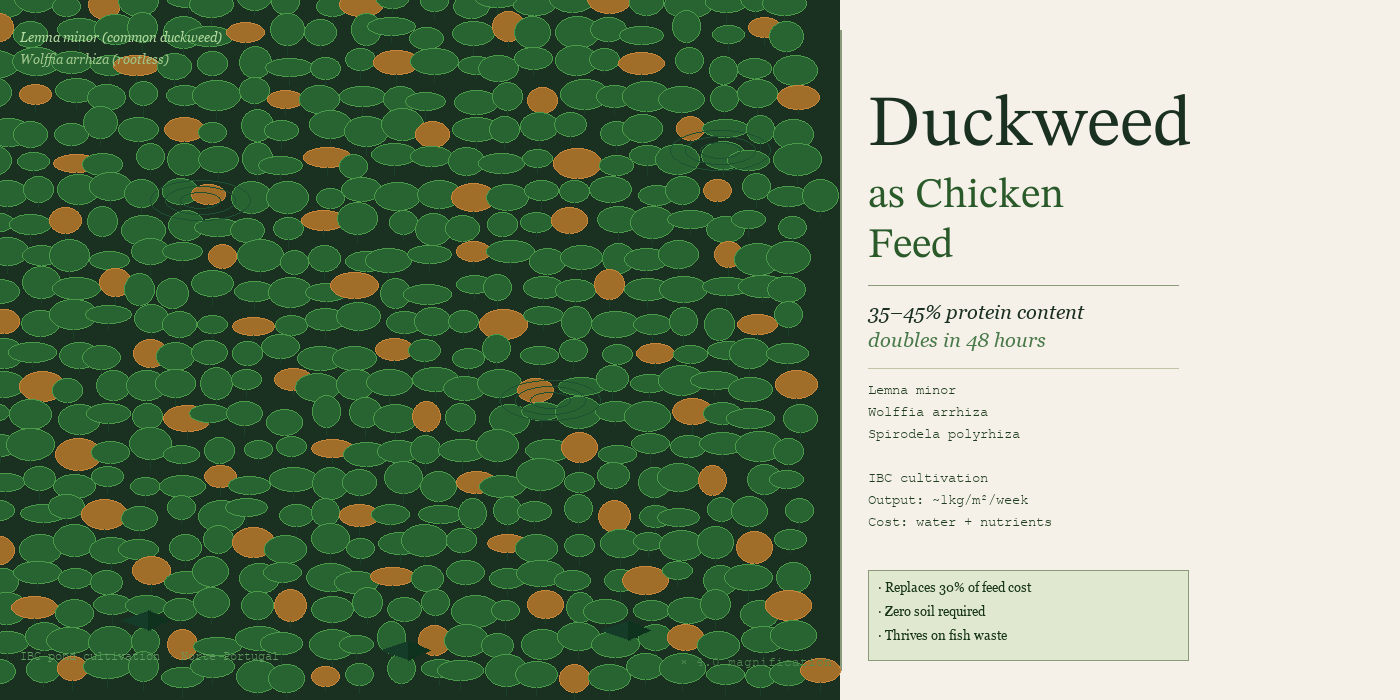
Duckweed is the smallest flowering plant in the world. A single frond of *Lemna minor* — the most common species — is approximately 3 mm across. A surface covered in it looks like green paint applied to still water. In warm, nutrient-rich conditions, a colony of duckweed doubles its biomass every 24–48 hours. By dry weight, it contains 35–45% protein with a complete amino acid profile comparable to soybean meal. For a small retreat running a flock of 6–10 chickens, a duckweed growing system reduces feed costs to near zero during the growing season and produces a farming loop that guests find genuinely interesting.
The biology is simple. Duckweed is a free-floating aquatic plant that takes up nutrients directly from water through its underside. It needs three things to grow at maximum rate: sunlight (direct or indirect), water temperature above 15°C, and dissolved nutrients — primarily nitrogen and phosphorus. In a nutrient-poor water source it grows slowly. In water that has received compost leachate, diluted fish pond water, or grey water from a reed bed filter, it grows explosively. This is the integration point: the same water that the fish pond or aquaponics system generates as nutrient-rich output becomes the growth medium for the duckweed, which then becomes the chicken feed.
Setup is minimal. Two 100-litre containers — recycled IBCs, old bathtubs, plastic tote boxes, or concrete troughs — positioned in a sunny spot. Fill with water. Add a small amount of diluted fertiliser (compost tea, diluted fish tank water, or a very weak liquid seaweed solution at roughly 1:100 dilution). Obtain a starter culture of duckweed: it is available from aquatic plant suppliers and online marketplaces for €5–€15, or it can be collected from any calm freshwater surface — canal, pond, drainage ditch — in spring and summer. The starter culture does not need to be large; a single handful will colonise a 100-litre container in two to three weeks under good conditions.
Harvesting is as simple as the setup. A fine mesh sieve, kitchen strainer, or piece of window screen draped across a bucket works perfectly. Skim the surface, allow the water to drain back into the container, and feed the fresh duckweed directly to the chickens. They eat it immediately and with enthusiasm. Chickens are not typically known for their enthusiasm about food novelty, but duckweed is an exception — possibly because of the high protein content, possibly because it is wet and cool and interesting. Either way, they eat it.
The yield calculation for a small retreat. A 100-litre container with a healthy duckweed colony covering the full surface produces approximately 40–80 grams of fresh duckweed per day under good summer conditions (equivalent to 8–16 grams dry weight). Two containers produce 80–160 grams fresh per day. A flock of 8 chickens requires approximately 120 grams of supplemental feed per bird per day if duckweed is a partial replacement — so two containers can supply a meaningful fraction (30–50%) of the flock's protein requirements during the warm months. Research trials have shown duckweed supplementation at up to 50% of feed replacement with no negative effect on egg production. At 100% replacement, production declines — it is a supplement, not a complete feed.
The integrated system. This is where duckweed moves from a curiosity to a genuine ecological loop. Fish pond generates nutrient-rich water → duckweed tanks receive this water as growth medium → duckweed harvested daily → fed to chickens → chicken manure goes to compost heap → compost heap produces leachate → leachate fed back to duckweed tanks. The loop closes. Each element is feeding the next. The cost of the entire chicken feed system, once the duckweed is established, is essentially zero. The cost of establishing the duckweed system — two containers, starter culture, one afternoon of plumbing — is approximately €50–€100.
Honest limitations. Duckweed grows poorly below 15°C. In North Portugal, water temperatures in outdoor containers drop below this threshold from approximately November through March — five months of the year. During this period, duckweed growth slows dramatically or stops. The chickens revert to commercial feed during winter, and the system resumes in April or May as temperatures recover. This is not a flaw in the system; it is a seasonal rhythm that mirrors how most productive food systems operate in the Minho climate. Plan for it by stocking more commercial feed through winter rather than expecting year-round duckweed production.
Biosecurity note. Duckweed grown in open containers in a Portuguese summer will at some point face competition from algae — particularly filamentous green algae, which can rapidly outcompete duckweed for light and nutrients. The most effective prevention is maintaining full duckweed coverage: a dense surface canopy shades out algal growth. If algae appear in significant quantities, remove manually, add fresh duckweed, and temporarily reduce the nutrient input (which tends to favour algae over duckweed in imbalanced systems). A shading cloth that filters 30–40% of direct summer sunlight can help in particularly hot periods — duckweed grows in bright indirect light; algae prefers the intensity of direct midsummer sun.
The guest story angle. Duckweed looks extraordinary. A container covered in it looks like a carpet of green velvet, or something out of a fairy tale pond. Guests who notice it while wandering the property consistently stop and ask what it is. The answer — that it is a high-protein plant feed for the chickens, growing on fish tank water, and harvested daily with a kitchen strainer — is both genuinely true and genuinely surprising to most people. The chickens eating fresh duckweed from a bucket is a two-minute show that requires no staging, no cost, and no management beyond keeping the system running. In the context of a retreat that wants to communicate ecological literacy and closed-loop thinking, duckweed is one of the most legible and immediate demonstrations available.