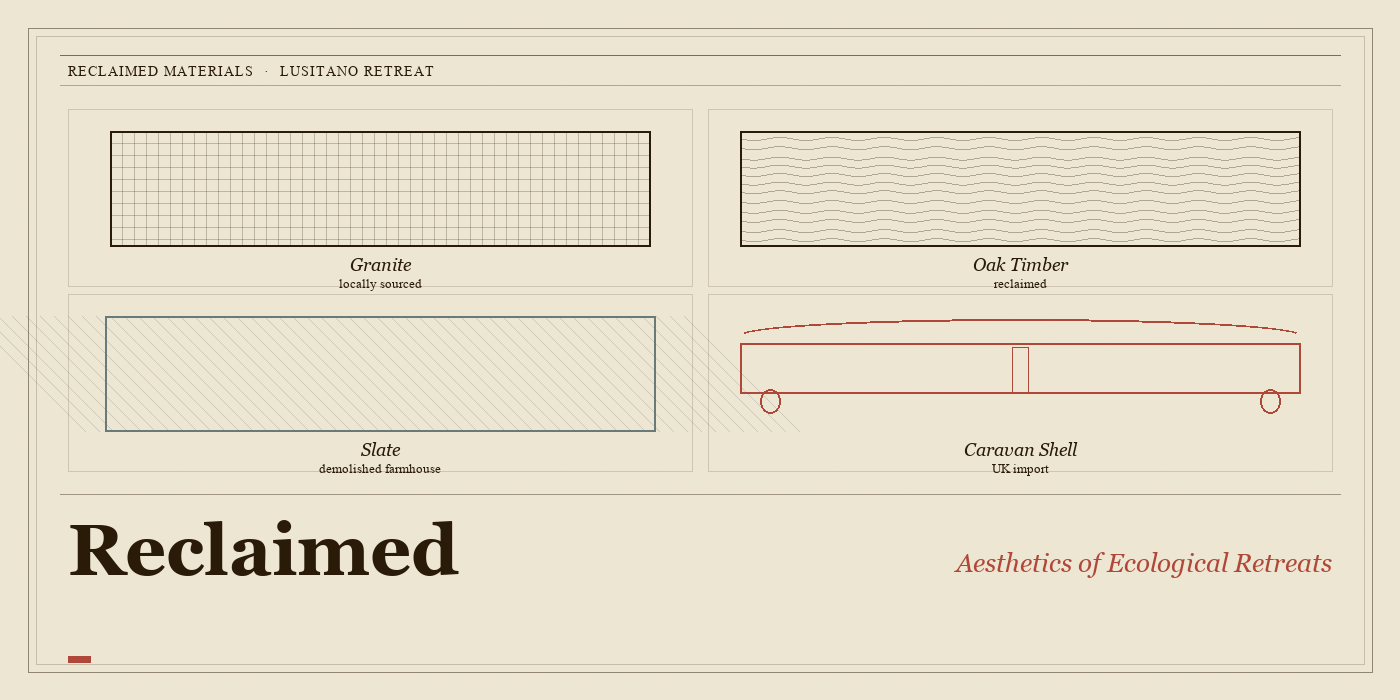
There is a question that comes up when you start planning a rural retreat using reclaimed materials: is this a financial decision, an aesthetic decision, or an ethical one? The honest answer is that at the scale of a small eco-retreat in North Portugal, it is all three simultaneously, and the decisions reinforce each other. Reclaimed stone costs less than new concrete block per finished wall. Reclaimed timber looks better than new timber for the purpose it is serving. And both represent materials that already exist rather than materials that required extraction and manufacturing. The case does not need to be argued separately for each of these registers. They converge on the same decision.
The UK caravan deserves specific attention because it is the structural starting point of the Lusitano Retreat accommodation model, and it is a reclaimed material that most people do not think of as one. A static caravan — sourced from a UK caravan dealer or auction house at end of service life — is a fully insulated, factory-tested structural shell. The steel chassis is engineered and BRE-tested. The wall construction — typically mineral wool between aluminium-framed panels — provides an insulation standard that a basic timber frame build in Portugal would struggle to match without careful specification. The transport cost from the UK to Norte Portugal, including a professional haulage contractor and Portuguese import duties, runs to approximately €2,500–3,500 per unit. The caravan itself, at end of life but structurally sound, costs €2,500–4,500 on the UK market. Total delivered: €5,000–8,000 for an insulated shell that you then clad, fit out, and landscape around.
The exterior cladding is where the reclaimed material logic becomes most visible to guests. Rough-sawn larch, sourced direct from a Portuguese or Galician sawmill rather than through a timber merchant, costs approximately €300–500 per cubic metre. For the exterior cladding of a single caravan unit — approximately 60–80 m² of surface area — you need roughly 1.5–2.5 cubic metres of timber, depending on board width and batten profile. Total cladding timber: €450–€1,250 at sawmill prices. At timber merchant prices for the same specification, add 40–60%. The difference is the relationship: a local Portuguese or Galician sawmill owner who understands what you are trying to do will often provide rough-sawn boards at better prices than catalogue, allow you to select boards with interesting grain, and advise on species and drying. This relationship is worth building.
Reclaimed stone in North Portugal is genuinely abundant, which makes it both cheap and culturally resonant. Granite is the native building material of the Minho — every abandoned quinta, every demolished wall, every old agricultural structure represents salvageable stone that someone needs to dispose of. The Junta de Freguesia — the parish council — is the correct first point of contact for sourcing demolished stone. Juntas frequently manage the clearance of abandoned structures on municipal land and have stone to move. A direct conversation, offered at the right moment, can secure a quantity of dressed granite at the cost of transport only. Demolition contractors working on private land are the second channel: they are paid to remove material, and reclaimed stone they can give away rather than take to a landfill is a straightforward benefit to them. Expect to pay €0–50 per tonne for stone sourced this way, versus €80–150 per tonne for new or reclaimed stone sourced through a materials dealer.
Reclaimed slate roofing is the other material that is both locally abundant and aesthetically superior to new slate for a retreat context. Portuguese slate — specifically the dark, fine-grained slate from the Trás-os-Montes and Minho regions — is a premium roofing material internationally. On the local market, reclaimed slate from demolished rural buildings is often available for the cost of removal. The condition matters: check for delamination (splitting along the grain) and for holes from previous fixing nails. Roof slates with small nail holes but otherwise sound can often be re-used with new copper clips rather than new holes. A qualified local telhador (roof worker) will assess reclaimed slates in situ and advise on re-usability rates. Expect 30–60% wastage on reclaimed slate from demolition sources, compared to near-zero on new slate — but the cost difference typically more than compensates.
The aesthetic argument for reclaimed materials is difficult to articulate precisely but easy to demonstrate visually. New timber, even high-quality new timber, has a uniform surface appearance: consistent colour, consistent texture, no character from previous use or weathering. It looks correct but it does not look interesting. Reclaimed timber — old floorboards from a Portuguese farmhouse, structural beams from a demolished barn, scaffold boards from a construction site — has visible grain, natural colour variation, occasional marks from previous use. These are not defects. They are the visual record of the material’s history. A guest who sits on a bench made from an old oak beam is sitting on something that was part of a building before they were born. This communicates something that new timber cannot communicate, regardless of quality or price.
The cost comparison between reclaimed and new construction materials deserves an honest treatment, because the story is more nuanced than ‘reclaimed is always cheaper.’ Reclaimed stone, sourced through Junta connections and demolition networks, is significantly cheaper than new concrete block or even than dressed stone from a quarry — perhaps 60–80% less per finished wall square metre when you account for the labour. But reclaimed timber from a specialist supplier can cost as much as or more than new timber, because the supply chain for quality reclaimed timber is less efficient. The advantage of going direct to the source — sawmill for new rough-sawn, demolition site for reclaimed timber beams — is that you bypass the margin that a specialist reclaimed supplier adds. The relationship does the work that the margin otherwise does.
What not to reclaim: anything with asbestos risk is the non-negotiable first answer. Corrugated asbestos roofing sheets (eternite or fibrocimento) were widely used in Portuguese agricultural buildings up to the 1980s. They are identifiable by their corrugated profile and dull grey-white surface finish. Do not handle them without professional assessment. Removal of asbestos-containing materials in Portugal requires a licensed contractor and specific disposal procedures. The presence of asbestos-containing sheets on a property being considered for purchase is not necessarily a deal-breaker, but it is a cost line that must be quantified before purchase. Budget €1,500–3,000 for professional asbestos removal of a typical agricultural outbuilding roof.
Old electrical wiring is the second category to avoid reclaiming. Aluminium wiring, used in Portuguese construction up to the 1970s, is a fire risk when connected to modern copper systems. Rubber-insulated cables degrade over decades and cannot be relied upon even where visually intact. When rehabilitating any existing structure, assume all wiring is to be replaced rather than reclaimed. The cost of a complete rewire for a small unit is €800–1,500 — a manageable line item that eliminates the risk entirely.
The single new-material exception is windows. This is the point where the reclaimed materials philosophy correctly yields to thermal performance requirements. Single-glazed timber windows, however beautiful, are thermal liabilities in a guest accommodation context: they admit cold in winter, they are draughty, and they require regular maintenance. The energy loss through old single-glazed windows in a unit that relies on a wood stove for heating can undermine the entire thermal strategy. PVC double-glazed windows are cheap and thermally effective but aesthetically incorrect for a premium rustic context. The right answer is thermally broken aluminium or timber-aluminium composite double-glazed windows in a profile that suits the building character: typically a simple rectangular casement in dark grey or brown. Budget €300–600 per window unit for this specification. In a two-unit caravan retrofit, you are fitting perhaps six to eight windows: €2,000–4,500 total. This is the one place where buying new is unambiguously the right decision.
The ethics of material reuse are worth stating plainly, not as marketing language but as operational logic. Every tonne of stone reused from a demolished building is a tonne of granite that does not require quarrying, crushing, dressing, and transporting. Every reclaimed slate tile re-fixed to a roof is a slate tile that does not enter a landfill. At the scale of a two-unit retreat, these are small numbers. But the practice creates sourcing relationships — with Juntas, with demolition contractors, with sawmills — that compound over time as the project grows. By Phase 3, when you are sourcing materials for a third and fourth unit, those relationships are worth significantly more than the cost difference between reclaimed and new.
The sourcing process for reclaimed materials in Norte Portugal is not a specialist activity. It is a conversation. Every builder, every Junta president, every demolition contractor in the Minho knows where there are old structures being cleared and materials that need to move. The conversation is simply: I am building a rural retreat, I am looking for old granite, old timber, old slate, and I can arrange collection. In a culture where personal relationships underpin most practical transactions, this conversation — held over a coffee at the Junta office or at a local fair — opens access to a supply chain that has no internet presence and no catalogue. That is precisely why it remains available.