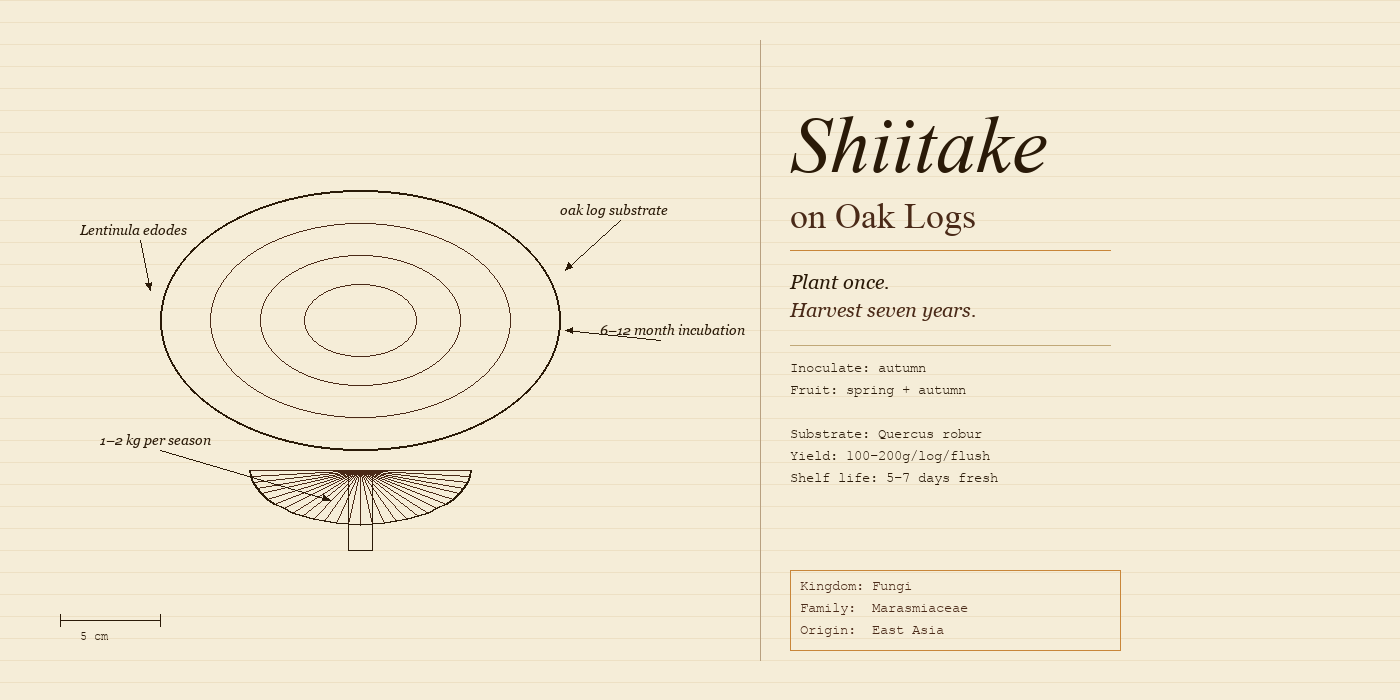
Among all the ecological systems we are building at Lusitano Retreat, shiitake mushrooms on oak logs have the best ratio of simplicity to impact. The setup requires no power, no water beyond rainfall, no temperature control, and no ongoing inputs except patience. The return is fresh mushrooms for the kitchen, a visually striking feature that guests photograph consistently, and an annual cycle that connects directly to the oak woodland management that happens on any property in North Portugal.
Shiitake (*Lentinula edodes*) is a wood-decomposing fungus native to East Asian forests. It has been cultivated on oak logs for over a thousand years in Japan and China, which means the cultivation method is extremely well-understood. The substrate is oak: specifically, freshly cut oak logs 10–15 cm in diameter and 1–1.2 m in length. In North Portugal, oak is abundant and cheap — any pruning of mature oaks on the property, or any local sawmill, produces suitable logs. The logs should be cut in late winter or early spring, when the bark is still tight to the wood and the water content is at seasonal maximum.
Inoculation method. Drill holes in a diamond pattern across the log surface — 5 cm deep, spaced 10–15 cm apart in rows 6–8 cm apart. Insert plug spawn (pre-colonised wooden dowels available from mushroom suppliers in Portugal and across Europe at approximately €10–€15 for 100 plugs — enough to inoculate 3–4 logs) into each hole. Seal each plug with food-grade beeswax or cheese wax melted over the plug and the surrounding bark. The wax seal protects the spawn from competing organisms and desiccation during the incubation period. Label each log with the inoculation date.
Incubation takes 6–12 months, depending on temperature and log density. During incubation, the mycelium — the white fungal network — colonises the interior of the log, slowly consuming the wood's lignin and cellulose. The logs should be stored in a shaded, humid location during this period: under a tree canopy, in a north-facing lean-to, or in any position that maintains high humidity without waterlogging. In the Minho climate, natural rainfall is usually sufficient. In dry summers, logs benefit from weekly soaking.
Fruiting triggers. A fully colonised log fruits when it experiences a thermal shock — a rapid temperature drop of 8–12°C. In the Minho, this happens naturally in autumn when October temperatures fall, and the first fruiting of the season is often spontaneous and abundant. Fruiting can also be triggered artificially by submerging the log in cold water for 8–24 hours — this mimics the heavy autumn rain that triggers wild shiitake to fruit. After soaking, stand the log upright in a humid, shaded area and watch for pinning within 4–7 days. Mushrooms develop from pin to harvest in approximately 5–7 days.
Realistic yield. A well-colonised 1-metre oak log of 12 cm diameter produces approximately 1–2 kg of fresh mushrooms per fruiting cycle, with 3–4 fruiting cycles per year depending on management. Over its productive life — typically 4–7 years — a single log will yield 12–25 kg of fresh shiitake mushrooms. At 20 logs, which is a modest starting number and fits into an area of 10 m², annual production is 60–160 kg of fresh mushrooms. This is not a commercial scale, but it is more than enough to supply a retreat kitchen and generate a surplus for guest experiences.
The guest experience angle is irreplaceable. A log yard — 20–30 inoculated oak logs standing in a shaded corner of the property — is visually interesting and immediately legible to guests: they can see the mushrooms growing, pick them before dinner, and understand the connection between the oak woodland around them and what is on their plate that evening. This single experience — 'we picked the mushrooms ourselves from the log yard and cooked them that night' — appears in reviews with striking regularity at retreats that offer it. It costs approximately €200 to set up and nothing to maintain.
A complementary system worth running alongside the oak log shiitake is oyster mushrooms (*Pleurotus ostreatus*) on wheat straw bales. Oyster mushrooms fruit in 4–6 weeks from inoculation (versus 6–12 months for shiitake), tolerate a wider range of substrates, and produce abundantly through autumn and spring. They are less culinarily prestigious than shiitake but more reliably productive and better suited to an indoor location — a cool, humid outbuilding is ideal. Running both systems gives the kitchen year-round supply: oyster mushrooms from October through April, shiitake in peak autumn and spring flushes.
The integration with other ecological systems is a design advantage worth noting. Spent mushroom substrate — the oak sawdust and colonised wood after the log is exhausted — is an excellent worm bin feedstock. Worm casts from spent shiitake substrate are among the highest-quality composts available. The cycle runs: oak log → shiitake mushrooms → spent substrate → worm bin → worm casts → vegetable bed fertility. The entire chain costs under €300 to establish and produces both food and soil amendment as outputs. This is what ecological system design looks like when it is working: nothing is a waste product.
A brief note on legal context. In Portugal, cultivated mushrooms (cogumelos de cultura) are treated differently from foraged wild mushrooms under food safety law. Selling foraged wild mushrooms commercially requires specific hygiene certification and traceability documentation that is difficult to obtain without a food business licence. Selling cultivated mushrooms grown on your own property and consumed by guests is considerably simpler — it falls within the normal self-catering food provision framework of an Alojamento Local. If you intend to sell surplus mushrooms at a local market, confirm with the local ASAE (Autoridade de Segurança Alimentar e Económica) office what documentation is required for cultivated mushrooms at small-scale direct sale.