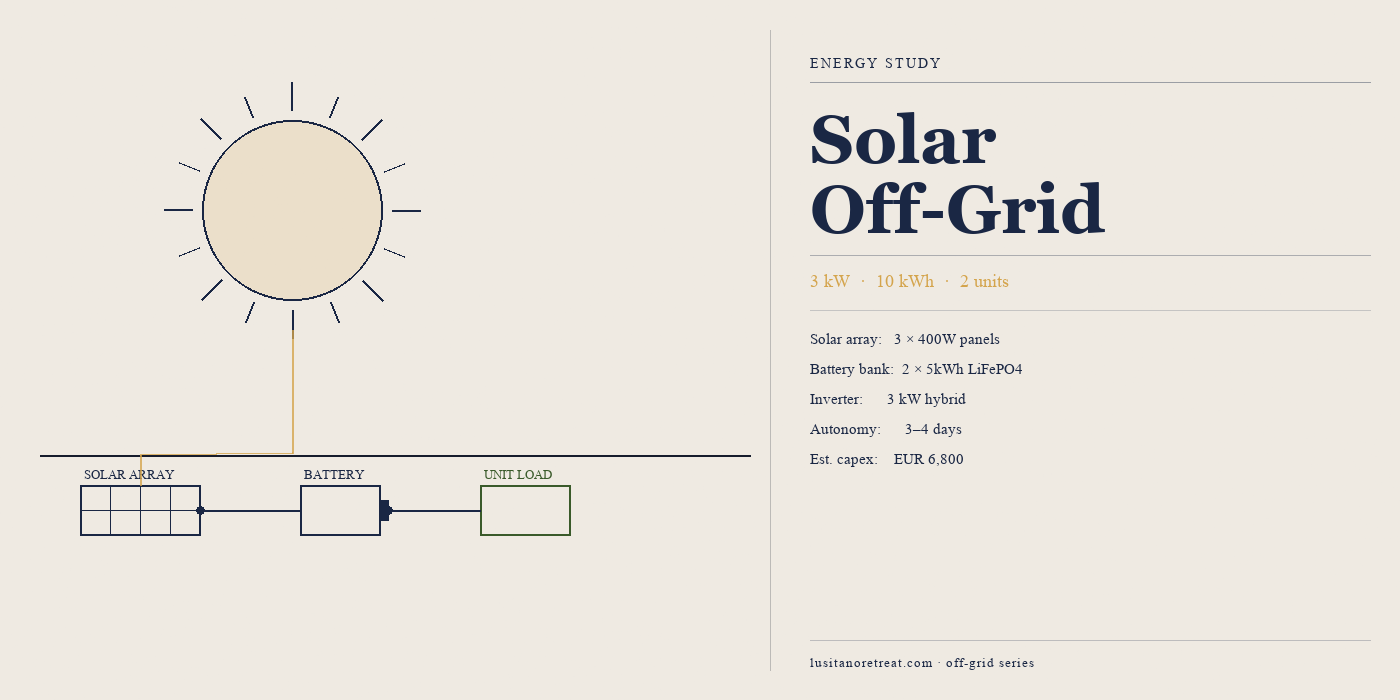
The first question when designing energy for a rural retreat is not how many panels you need. It is whether you are connected to the grid at all. This sounds like a philosophical question but it is actually a financial one, and the answer has direct implications for guest experience, operating risk, and capital allocation. Getting it wrong in either direction is expensive. Going fully off-grid when grid connection is available costs more and reduces reliability. Staying fully grid-dependent in a rural location where the connection cost is high means paying €1,500–3,500 for infrastructure that solar would replace anyway. The right answer for most small rural retreats in Norte Portugal is neither: solar-primary, grid-connected as backup.
A 3 kW solar array in the Minho generates approximately 3,500–4,000 kWh per year. That figure sounds abstract until you put it next to what two accommodation units actually consume. Guest electricity use in a two-unit retreat with no electric heating, no electric cooker, and no electric water heater is modest: lighting (LED throughout), phone and laptop charging, a small refrigerator, a water pump, a router. Total load per unit: roughly 3–6 kWh per day in summer, 2–4 kWh in winter (less air conditioning, more lighting). Two units: 6–12 kWh per day peak. A 3 kW array at Minho irradiance levels produces 9–12 kWh per day in the main season. The system covers demand.
The 10 kWh battery bank is the element that converts a daytime solar system into something useful for guests. Solar generation peaks between 10:00 and 16:00. Guest demand peaks in the morning (kettle, shower pump) and evening (lighting, cooking if there is a hob). Without battery storage, the system would export surplus midday power and import grid power in the morning and evening — which eliminates most of the financial benefit. With a 10 kWh battery, morning and evening loads are covered by stored energy. The battery does not need to be large enough to survive three consecutive cloudy days. That is full off-grid thinking, and it requires a 20–30 kWh bank, which costs €15,000–20,000. The 10 kWh buffer — costing €3,000–5,000 as part of the installed system — is what makes grid-connected solar economically sensible.
The total installed cost of a 3 kW array with a 10 kWh lithium battery, hybrid inverter, mounting, wiring, and installation in Norte Portugal is €8,000–12,000. This includes the inverter (the most important single component — do not save money here; a Victron or SMA hybrid inverter at €1,200–2,000 is the correct choice), the battery bank (LiFePO4 chemistry is the only practical choice for a system that will cycle daily for 10+ years), the panels (standard 400W monocrystalline, 8 panels for a 3.2 kW array), mounting structure, DC cabling, and a licensed electrician for connection and commissioning. The grid connection itself, if not already present, adds €1,500–3,500 depending on distance from the nearest E-REDES infrastructure.
What uses the most power is worth knowing before you design the system, because the answer determines whether your calculation works at all. The electric kettle draws 2–3 kW and runs for three minutes: a single boil uses 0.15 kWh, which sounds trivial but repeated six times a morning is nearly 1 kWh before 9:00. The immersion heater for hot water is the real problem: a standard 3 kW immersion element running for two hours to heat a 100-litre tank uses 6 kWh — more than half the daily solar budget in winter. This is the number that forces the choice. If you use electric immersion heating for hot water, your solar system needs to be significantly larger to compensate. The correct solution is a wood-fired back boiler or a gas combi boiler for hot water, with solar covering everything else. This is not a compromise — it is the right system design.
The wood stove or pellet stove as primary heat source is not a concession to rustic aesthetics. It is the correct engineering decision for an Atlantic climate retreat operating on a solar budget. A well-insulated timber-framed unit or rehabilitated ruin with a €600–€1,200 cast iron stove and a back boiler for hot water requires zero electrical energy for heating and hot water. The stove is a guest experience asset and an infrastructure asset simultaneously. Combine it with solar for lighting and low-load appliances and you have a system that is genuinely resilient: it works on a cloudy December week when the battery is low and it works on a hot July day when guests are not using heat at all.
AC vs DC coupling is a detail that matters when you are specifying the system, because it affects which components you can buy and how efficient the energy conversion chain is. AC-coupled systems — where an existing grid-tied inverter is paired with a separate battery inverter — are more flexible and easier to retrofit if you already have a solar installation. DC-coupled systems — where solar charge controllers send power directly to the battery bank before inversion — are slightly more efficient (eliminating one conversion step) and are the correct choice for a new installation. For a 3 kW system with a 10 kWh battery being installed from scratch, specify DC coupling with a hybrid inverter that handles both solar input and battery management in a single unit. This simplifies wiring, reduces failure points, and gives you a single monitoring interface.
The sequencing question — when to install solar relative to other infrastructure — has a clear answer that is often counterintuitive. Install solar before or concurrent with the first accommodation unit, not after. The reason is cost: in a rural Norte Portugal location where the nearest grid connection is 200–500 metres away, a grid connection quote will frequently exceed €3,000 and sometimes reach €8,000 depending on terrain and cable routing. A €10,000 solar installation that eliminates the need for that connection pays for itself in year one. If the grid connection is nearby and cheap, the calculus changes — but even then, grid-connected solar makes sense as the primary system because it reduces ongoing electricity costs and provides operational resilience.
The EV charger question is increasingly relevant for UK and German guests, who now travel to Portugal in electric vehicles at a meaningful rate. A 7 kW AC wallbox costs €800–€1,200 installed. It should be on its own circuit and ideally controlled so it only charges when solar generation is above a threshold — most modern wallboxes support this via simple automation. Do not try to charge an EV from your 3 kW solar array without this control: a guest plugging in at 08:00 will drain your battery bank and leave nothing for lighting or pump loads by afternoon. Smart charging — triggered only when midday solar surplus is available — makes EV charging a genuinely free amenity rather than a grid cost.
The honest math on what solar saves versus what it costs is worth stating plainly. At current Portuguese electricity tariffs (€0.22–0.26/kWh for households), a system generating 3,800 kWh per year and self-consuming 70% of that output avoids approximately €580–680 in annual electricity purchases. At €10,000 installed, the simple payback is 15–17 years — not a financial investment in any conventional sense. The real case for solar at a rural retreat is not the electricity bill. It is the grid connection cost avoided, the operational resilience gained, the marketing story it enables, and the fact that it is simply the right infrastructure for a site that is presenting itself as ecologically serious. These are real, if harder to quantify, benefits.
One thing that frequently appears in solar planning conversations and should be addressed directly: battery backup for a full off-grid system during the Atlantic winter. The Minho receives significantly less solar irradiance between November and February than in the summer — average generation from a 3 kW array drops to roughly 200–300 kWh per month in December versus 500–600 kWh in June and July. A 10 kWh battery provides roughly 2–3 days of modest autonomy in winter conditions. For a guest-facing retreat that cannot afford dark evenings, this means the grid connection matters most in winter. Do not design the system as if winter is the same as summer. Design it for summer self-sufficiency and winter grid assistance. That is the system that works.
The boiler as backup — a gas or pellet boiler that takes over hot water and heating when solar is insufficient — is not a failure of the system design. It is the system design. Every serious off-grid or near-off-grid project has a backup heat source, because the alternative is a guest without hot water on a cold February morning, which is not acceptable in any accommodation rated above €80 per night. Design the system honestly, sequence it correctly, and do not try to run electric immersion heating from a 3 kW solar array. Everything else follows from those three decisions.